So, can you put baby bottles in the dishwasher, and how can you go about properly cleaning their baby bottles?
When it comes to your baby’s bottles and feeding utensils, it is absolutely essential that you use the correct equipment and supplies.
If this is not done correctly, your baby could be exposed to a number of serious diseases or infections, including diarrhea.
All parents worry about the health and safety of their children. During your child’s first year, they are more prone and at risk of different sicknesses, making it very important that you prioritize their hygiene.
In this article, we will be discussing whether or not it is safe to use the dishwasher for this task. More so, we will mention a few other ways in which you can safely clean your baby bottles.
Table of Contents
Is It Safe To Wash Baby Bottles In The Dishwasher?
There are plenty of variations to choose from if you are on the market for new baby bottles.
With that being said, not all bottles are dishwasher-safe. For example, if you have invested in a thin plastic bottle, you will be better off simply washing the dish by hand. On top of this, insulated mugs and containers should not be placed in the dishwasher.
For this reason, if you have a travel bottle, you may want to consider alternative washing techniques.
Dishwasher Accessories And Features For Cleaning Baby Bottles
Fancy dishwasher accessories are not necessary to clean baby bottles effectively.
You can use your regular dishwasher to clean the bottles by placing them on the top rack and the nipples and small parts in the silverware basket.
However, there are some dishwasher accessories available that can make the cleaning process easier and more efficient for baby bottles.
Third rack for nipples
Certain dishwashers include additional racks that are specifically designed to clean small items such as baby bottle nipples, lids, and other oddly shaped parts that may not fit in other compartments.
This feature can be especially useful for maximizing dishwasher space and can also be used for flatware, measuring cups, and other small items.
The third rack is typically located at the top of the dishwasher and is often removable for added convenience.
Basket for bottles Parts
In case your dishwasher does not have an additional rack, you can purchase a basket to hold nipples and rings.
I have found that using an OXO basket has made cleaning baby bottles much easier and efficient, and I regret not discovering it sooner.
The basket can hold up to eight bottle parts and has a lid to prevent any spillage.
The best part is that you can continue using the basket even after your baby has outgrown the bottles to store small items such as lids, pacifiers, measuring spoons, and more.
Sanitise cycle
The sanitise cycle is a useful feature that can be found in some dishwashers and is particularly effective in reducing germs and eliminating most bacteria on baby bottles, nipples, and breast pump parts.
This cycle utilises hot water that is heated to a minimum temperature of 150°F to thoroughly clean and sanitise baby bottles.
Depending on the model, some dishwashers have an automatic sanitise cycle that can be programmed and left to run, while others require a manual sanitise cycle that must be initiated manually.
Dishwasher bottle wash jets
Some dishwashers are equipped with bottle jets that are designed to clean baby bottles and other items with narrow openings effectively.
These bottle wash jets are located on the top rack of the dishwasher and are angled at 45 degrees to remove any residue inside the bottle.
They can also be used to clean other items such as coffee pots, tea kettles, and more.
How To wash Baby Bottles In The Dishwasher
With that being said, most baby bottles should be safe to simply clean in the dishwasher. This is especially true for everyday bottles that are made to be more durable and long-lasting.
So, how can you go about safely cleaning your baby bottles in the dishwasher?
The first thing that you will need to do is take the entire bottle apart. In other words, separate the bottle from the lid and open up any compartments.
This will ensure that the entire bottle is cleaned and that no bacteria can build up in hard-to-reach places.
Before putting the bottle in the dishwasher, rinse it under some warm or hot water. Make sure that you rinse every single part of the bottle, including any caps, lids, etc.
You can then place all the components into the dishwasher. Make sure that you put all of the smaller items into a basket or mesh laundry bag so that they do not end up in the dishwasher filter.
It is highly recommended that you set your dishwasher to a more powerful cycle.
More so, the temperature of the water should reach at least 100 degrees in order to thoroughly clean the bottle and kill any bacteria.
Once the cycle is complete, remove the different components from the dishwasher. Make sure that you wash your hands with soap before removing the bottle.
If the items are not fully dry, place them on a paper towel and leave them to air dry for an hour or so.
Do not use a towel to manually dry the bottle, as this could transfer new germs.
When Can You Start Using The Dishwasher For Cleaning Baby Bottles?
Some parents wait a few weeks before starting to put their baby bottles in the dishwasher however, you can start washing your baby bottles in the dishwasher from day 1.
As long as you follow the proper cleaning and sanitising guidelines.
However, it’s always a good idea to consult with your paediatrician for specific recommendations based on your baby’s individual needs.
Can You Use A Steriliser Instead Of A dishwasher?
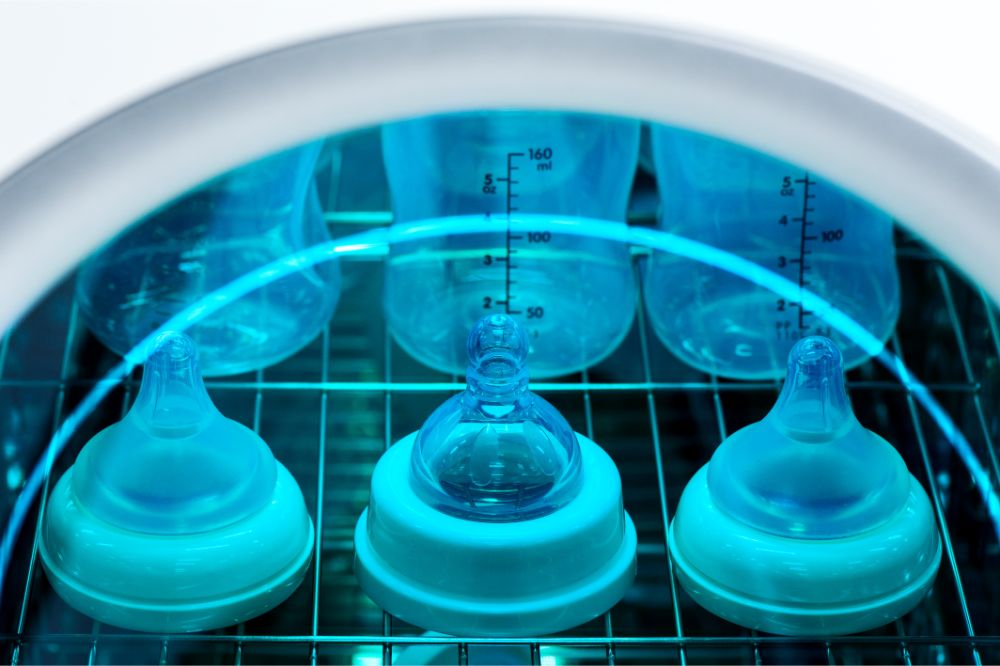
A steriliser is a great alternative to washing your baby bottles in the dishwasher.
It is important to note that there are sterilisers specifically designed to clean baby bottles.
In short, these are small plastic containers that can be used to safely and effectively remove any germs and bacteria from the bottles.
A microwave steam steriliser is arguably the most popular and commonly used product. This steriliser ultimately destroys harmful bacteria through the use of steam.
If you invest in one of these products, you will not have to purchase any additional detergents or chemical cleaning agents.
This also ensures that the plastic of the baby bottle does not deteriorate over time. More so, many parents would prefer avoiding chemical substances.
How To Use A Steam Steriliser
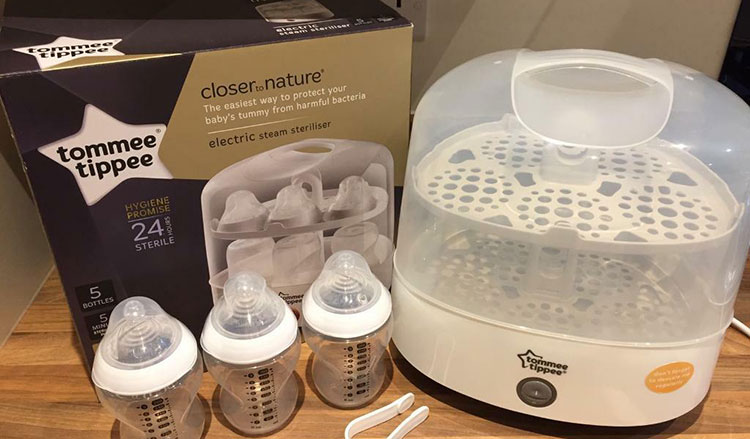
In order to use a steam sterilizer, you should start by rinsing out the baby bottles.
Once any debris is removed, simply place the bottles into the sterilizer. They should be placed upside down.
All of the additional components of the bottle will also need to be placed inside, including the lid and caps.
Unlock the lid of the product and fill it with about 200ml of cold water. It is important to note that some sterilizers are bigger and will require more water.
However, this also depends on how many bottles you will be cleaning at the same time.
Close the lid of the sterilizer and ensure that it is properly latched. The unit can then be placed in the microwave.
Your sterilizer should recommend how long the bottles should be placed in the microwave. It is very important that you do not overheat the sterilizer, as this could melt the plastic.
Be sure to adhere to the cooling down period in order to avoid steam or hot water burns.
It is important to note that not all baby bottles can be placed in the microwave.
For this reason, you will need to ensure that the bottles you purchase are microwave-safe before investing in a steam sterilizer.
Parents use this product to clean a number of baby products. With that being said, below are a few products that should not be cleaned with a steam sterilizer:
- Latex soothers
- Any metal objects
- Rattles and toys
Hand Washing The Baby Bottles
If you have metal or rubber-insulated products, it is highly recommended that you simply hand wash the bottles.
There are a number of chemical detergents that can be used to do this.
Before cleaning the bottles, you will need to wash your own hands thoroughly.
More so, be sure to remove all the different components of the bottle, such as the lid and cap. This will ensure that every bottle’s surface is cleaned, removing germs and bacteria in hard-to-reach areas.
Once the bottle is taken apart, start by rinsing it – this water can be cold or warm. Rinsing it will remove any debris left over from feeding time.
In order to thoroughly clean the bottles, you should use water that is at least 100 degrees Celsius.
However, since this is too hot to work with, you will need to leave the bottles to soak in the hot water for a few minutes.
This will ensure that all germs and bacteria are removed.
Final Thoughts
Many parents wonder whether or not baby bottles can be safely put in the dishwasher.
This depends on the type of material that your bottles are made of. For example, rubber-insulated bottles should be washed by hand.
To thoroughly clean your bottles in the dishwasher, be sure to remove all the different components.
Set the dishwasher to a powerful setting and make sure the temperature reaches at least 100 degrees Celsius. Leave the bottle to air dry on a clean, dry towel.
Related articles:
- Does A Dishwasher Need Hot Water
- How To Unblock A Dishwasher
- How Much Salt To Put In The Dishwasher
- Can You Put Wooden Spoons In The Dishwasher (Danger!)

Founder of homeappliancegeek.com, avid cook, and lover of Asian food.
Signature dishes include Thai Red Curry, Chicken Saag, Bibimbap and Sushi.
Massive clean freak; a habit baked-in after spending 9 years in the catering industry.
The one appliance he couldn’t live without? Easily the dishwasher (total relationship saver!).