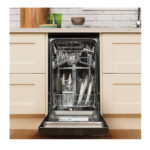
Integrated dishwashers seem to be at the height of their popularity now. Everyone seems to want an integrated dishwasher and it’s no surprise why.
Unlike their unintegrated counterparts, integrated dishwashers are extraordinarily sleek and smart. They allow you to have the functionally and practically of having a dishwasher, without anyone ever knowing it is there.
However, many people may be unsure of exactly what an integrated dishwasher is, and that is what we are going to explain to you in this article.
So, if you have been hearing all the talk about integrated dishwashers and are wondering what one is and the benefits of getting one, this article is for you.
What does Integrated Dishwasher mean?
To understand what an integrated dishwasher is we first need to know what integrated means. The definition of integrated is this;
combining or coordinating separate elements to provide a harmonious, interrelated whole.
To put it simply, integration means making something that would normally be separated, into a whole.
In the context of dishwashers, this means that instead of a dishwasher being freestanding and just sitting somewhere in your kitchen or outhouse, integration seamlessly makes it a part of your kitchen.
A freestanding dishwasher is designed to stand alone by itself, just like a washing machine or tumble dryer would. An integrated dishwasher, however, is designed to be permanently fitted within your existing kitchen cabinet space.
An integrated dishwasher is delivered without a front panel, and this is because you will need to purchase and fit a front panel that matches your existing kitchen cupboard design.
There are many reasons why people prefer integrated dishwashers over freestanding dishwashers, and that is something we will go into more depth on later in the article.
What Are The Benefits Of An Integrated dishwasher
There is a multitude of reasons why most people prefer integrated dishwashers.
Integrated dishwashers can either be exposed or hidden based on your preference.
That means if you don’t like the look of having a dishwasher and you don’t want it to be displayed, then you can simply have it hidden behind a cabinet door.
One of the main reasons people prefer integrated dishwashers is that they are customised and designed for your kitchen.
This means they can fit into the theme of your design and make your kitchen look more put-together and smart; perfect for people who love a minimalistic style.
Any Cons To having integrated dishwashers
There are some negatives to integrated dishwasher:
- Cost: Integrated dishwashers tend to be more expensive than freestanding models. This is because they require custom installation and often have higher-end features and finishes.
- Limited mobility: Once an integrated dishwasher is installed, it cannot be easily moved or relocated. This can be problematic if you decide to remodel your kitchen or move to a new home.
- Design limitations: Integrated dishwashers are designed to blend in with your kitchen cabinetry and may not offer as many design options as freestanding models. This can limit your ability to choose a dishwasher that matches your preferred style or color scheme.
Who are integrated dishwashers for
Integrated dishwashers are designed for homeowners who want a seamless and integrated look in their kitchen.
They are ideal for those who prioritize a clean and cohesive aesthetic and want their appliances to blend in with their cabinetry.
Integrated dishwashers are also suitable for those who have limited space in their kitchen and want to maximize their available storage.
Their also a good choice for those who prioritise quiet operation, as they are often designed to be quieter than freestanding models.
What Are Semi Integrated Dishwashers
Semi-integrated dishwashers are a type of dishwasher that has a visible control panel on the front of the appliance, but the controls are partially integrated into the design of the dishwasher door.
This means that the control panel is not completely visible, as it is partially covered by the dishwasher door.
Semi-integrated dishwashers are designed to provide a balance between the seamless, integrated look of fully integrated dishwashers and the easy access to controls of freestanding models.
They are often installed under a counter or into a cabinet, and the control panel is typically located on the top of the dishwasher door.
This is a popular choice for those who want a sleek and modern look in their kitchen, but also want the convenience of easy access to the dishwasher controls.
What is a fully integrated dishwasher
A fully integrated dishwasher is a type of dishwasher that is designed to blend in with your kitchen cabinetry and be completely hidden from view.
These dishwashers have a custom panel that matches the design and finish of your kitchen cabinets, making them indistinguishable from the surrounding cabinetry.
The control panel is located on the top edge of the dishwasher door, so it is only visible when the door is open.
Fully integrated dishwashers are installed under a counter or into a cabinet, and they are typically more expensive than semi-integrated or freestanding dishwashers.
Freestanding VS Integrated Dishwashers

Image credit: Bosch Home UK
Now we know what an integrated dishwasher is and what benefits they can bring; we can compare both the freestanding and integrated dishwashers to see the positives and negatives of both so we can see which one is right for you.
A potential factor that may affect which one is right for you is movability. Because a freestanding dishwasher is a stand-alone unit, it can be moved as much as you want and placed anywhere.
Integrated dishwashers are secured in place within the cabinet space, so cannot be moved easily.
Something else worth noting is that freestanding dishwashers are much more practical than integrated dishwashers.
If there are ever issues with an integrated dishwasher, it is much more effort to remove and return the appliance, since it is permanently fitted within the kitchen cabinet space.
With a freestanding dishwasher, issues can be fixed relatively stress-free.
Lastly, an integrated dishwasher will only look smart once you have fitted a front panel to it that matches your existing kitchen cabinets.
You should first check that you can purchase the panel beforehand, as this may be an easy job if you have a relatively new kitchen, but if you have inherited the kitchen and not sure where the cabinet doors were purchased from, then you may have a tough search on your hands.
What to Look for in an Integrated Dishwasher
Now that you know exactly what an integrated dishwasher is, you’re going to want to know what to look for when you go shopping for one. Let’s take a look at some of the most important aspects.
Load Capacity
The loading capacity of a dishwasher is measured using what is known as ‘place settings’.
A single place setting consists of 10 items, and these items are generally considered a side plate, a dinner plate, a mug, a bowl, a saucer, a knife, a drinking glass, and 2 teaspoons.
The majority of full-sized dishwashers can house anywhere between 12 to 15 settings, while slimline dishwashers hold about 9 to 11.
Depending on how large your home is, you might want to consider purchasing dishwashers that have larger capacities.
The same applies to small households – if you do not think that you are going to fill the machine up before you use it, you would do better by purchasing a slimline model.
Energy Rating
Be sure to take a look at the ‘A’ rating or check the estimated annual costs of operation to help compare the energy rating of the different models that you are looking at.
The greater the A rating, the less energy the dishwasher is going to use when it is in use. More modern machines with water-saving features and newer technology will help you keep your utility bills as low as possible.
Adjustable Layouts
Being able to alter the configuration of the inside of a dishwasher can be super beneficial.
Be sure to check whether the uppermost rack can be moved down or up to provide you with more space for taller wine glasses at the top or larger pans at the bottom.
Prongs that can be stood up or laid down flat to allow different item sizes to be held in place can be super helpful.
What’s more, it can be very useful to have flexible items in your dishwasher, like a removable cutlery tray, which means that you can fit in bigger dishes or pans.
Settings and Functions
All dishwashers should come with some of the more standard settings, such as heavy soil, a standard wash, and a light or quick wash.
Machines with higher specifications might offer more advanced features and come with sensors to determine and adjust the temperature, power, and amount of water that your machine uses for each of the wash cycles.
Many of the more modern models include ‘eco modes’ that can help you save electricity and water, which can be very useful if you are on a budget.
However, you should definitely keep in mind that ‘more efficient’ sadly does not translate to ‘clean best’, so while you might be saving money on your utility bills, the results you get from that might not always be as favourable.
Be sure to take a look at all of the settings that are on a dishwasher to ensure that it comes with any of the special functions you might want.
Noise Level
The noise level of any dishwasher will be measured in decibels and is generally going to tell you how loud the dishwasher is when it is working on its highest setting.
The make, type, and model of the machine will influence how loud it is. Be sure to check and ensure that it is not too noisy if this is important to you.
Generally, freestanding dishwashers are much louder than integrated dishwashers, especially slimline versions. This might be a consideration that you think about if your kitchen and living space is open-planned.
Do Integrated Dishwashers Need a Cabinet?

Integrated dishwashers do not need cabinets since they fit between end panels and cabinets. They actually don’t sit within a cabinet, like an integrated fridge or single oven does.
They are placed on the floor but have to be in between end panels or cabinets. Integrated dishwashers need to be supported. Integrated dishwashers also have to have a door that will be installed onto the machine’s front.
Capacity and Size
Integrated dishwashers are usually about 24 inches wide and can hold about 15 standard place settings. If your family consists of more than 2 people, integrated dishwashers are ideal.
They can wash many dishes at once. Freestanding machines are generally not as big. They hold about 8 place settings – perfect for apartments and small homes for three or fewer occupants.
Installation and Cost
Freestanding dishwashers will usually cost less than their integrated counterparts. Both machine types have cycles that save energy to keep your utility bills low.
But freestanding units do not require any special installation processes. They generally hook up to your kitchen faucet to drain straight into your sink as well.
On the other hand, integrated dishwashers have to be installed. This can incur more costs if you are hiring a plumber to connect or install water lines.
Additionally, if the cabinets in your kitchen do not have any openings, the modifications needed result in more costs.
Top Integrated dishwasher on the market
COMFEE’ KWH-BD1215P-W Fully Integrated Dishwasher

We recently purchased the COMFEE Fully Integrated Dishwasher and were extremely impressed with its performance.
The dishwasher is easy to install and has a sleek and modern design that blends in perfectly with my kitchen cabinetry.
The 12 place settings capacity is perfect for our needs and the different wash cycles allow me to customise the cleaning based on the type of dishes we’re washing.
We were pleasantly surprised by how quiet the dishwasher is during operation. It runs so quietly that we often forget it’s even on!
The dishwasher also has a delay start feature which is very convenient, as we can set it to run during off-peak hours to save on energy costs.
One thing to note is that the dishwasher does not come with a door panel and handle, so you will need to purchase those separately. However, this allows you to customise the appearance of the dishwasher to match your kitchen design.
Wrap Up
Thank you for reading our article. We hope we have been able to give you a better understanding of what integrated dishwashers are and some of the reasons why you may or may not want to get one.
Whether or not you decide to get an integrated dishwasher is completely up to you. Just do whatever suits you best!
Leave a comment and let us know if you are interested in getting an integrated dishwasher for yourself and why.

Founder of homeappliancegeek.com, avid cook, and lover of Asian food.
Signature dishes include Thai Red Curry, Chicken Saag, Bibimbap and Sushi.
Massive clean freak; a habit baked-in after spending 9 years in the catering industry.
The one appliance he couldn’t live without? Easily the dishwasher (total relationship saver!).