ZeroWater filter not draining properly?
ZeroWater are commonly cited for their effectiveness and relative affordability. It’s no wonder that they’ve become so popular across many households of various family demographics.
However, despite their efficacy, they aren’t entirely infallible and can stop working properly after a while.
In this article, you’ll learn what causes ZeroWater filters to drain slowly and what you can do to fix it.
So let’s take a look at ZeroWater filters and what you can do if yours is not draining properly.
What Is A ZeroWater Filter?
True to their title, ZeroWater filters are water filters that work to remove any and all trace amounts of contaminants, inorganic compounds, and solids like dirt.
They’re particularly effective in removing chlorine, lime, lead, glyphosate, microplastics, and PFAs. The result is a pure, clean taste devoid of any nasty contaminants.
Most water filters you will come across follow a simple 2 to 4-step filtration process. Each step works to remove a specific chemical, compound, or contaminant.
4-step filtration processes are rigorous enough to remove most harmful substances from the water, but not all of them.
Unlike other water filters, ZeroWater filters adhere to a 5-step filtration process. This process results in even purer water quality that most filters are simply incapable of matching.
Each of the five steps can be ascribed to a different physical component of the filter. They are as follows:
- The coarse basic filter removes fine particles and sediment.
- The foam divider works to evenly distribute the water over other parts of the filter, improving its efficiency.
- Activated carbon and oxidation reduction alloy filters a variety of contaminants and is particularly effective against chlorine. It also removes heavier substances and prevents mold.
- An ionization exchanger displaces foreign ions within the water, thus purifying it.
- Finally, the ultra-fine sieve and non-woven membrane layers remove any remaining fine particles.
Reasons Why Your ZeroWater Filter Is So Slow
ZeroWater filters are incredibly popular across a variety of households.
After all, the need for clean water is not exclusive to any one group of people, and ZeroWater’s unique 5-step filtration process has proven to be effective.
However, like all other devices, ZeroWater filters are not infallible.
With enough rigorous use, their efficacy will begin to wane.
Additionally, the presence of minerals, chemicals, and good old-fashioned dirt can severely impact their draining and filtration speeds.
Fortunately, for every problem, there’s a solution.
Keep reading, and we’ll show you how to get your ZeroWater filter back to its former state.

Trapped Air Bubbles
By far, the most common reason for ZeroWater filters being slow to drain is the presence of air bubbles within the filter itself.
This phenomenon can occur within both old and new filters alike and can also affect your filter’s dispenser and pitcher.
Air bubbles form when the contents of the filter begin to settle while in transit or later during the filtration process.
This causes the flow of water to slow down or otherwise stop entirely due to the pressure both above and below the air bubbles.
Naturally, you’ll want to amend this issue sooner rather than later. You can accomplish this in one of two ways: tapping or squeezing.
Tapping requires you to remove the filter and reservoir from the pitcher or dispenser, then lightly tap on the side of the filter to break up the air bubbles.
Once that’s done, you will need to add an inch of water to the reservoir, then place both it and the filter in the sink.
Allow the water to run through the filter and into the sink; this should adequately displace the air bubbles.
The squeezing process is a bit more direct. Start by carefully lifting the reservoir, then squeeze the mid-section of the filter around four or five times while water runs through it.
This action should be enough to displace the air bubbles.
After completing either method, simply re-insert the filter and reservoir.
Old Filter
ZeroWater filters have a “lifespan” of approximately 20 gallons. Once they’ve filtered this amount of water, you should replace them immediately.
Unfortunately, most people tend to put this off until it’s too late, making this the second most common reason for filter blockages.
Over time, sediment and TDS will begin to clog the filter. Eventually, the pore spaces of your filter will be full of contaminants, thus drastically stifling the flow of water.
Now, it is possible that your ZeroWater filter can last beyond the recommended 20 gallons of water, provided that your water doesn’t contain too much TDS.
Still, this may be unlikely, and if your water has a high amount of TDS, the filter may not even last the full 20 gallons. Remember that this number is an approximation.
Fortunately, there are ways to determine how often you will need to replace your filter, or rather, how long it will last. It all depends on the TDS of your tap water.
| TDS | Lifespan |
| 000 – 001 | 40 + gallons |
| 002 – 050 | 40 gallons |
| 051 – 200 | 25 – 40 gallons |
| 201 – 300 | 15 – 20 gallons |
| 301 – 400 | 8 – 15 gallons |
| 400 + | 8 gallons or fewer |
It’s recommended that you test your filtered water periodically with the use of your water quality meter, which should be included in the product itself.
Housing Area Blockage
The housing area of your ZeroWater filter is prone to becoming clogged with dirt.
The effects may be unnoticeable at first, but over time, they will become much more prominent, making your filter agonizingly slow.
It’s important to understand that this type of blockage is not unique to ZeroWater filters. In fact, blockages can occur in filters of any type.
However, they are far more common when it comes to filters that need to be twisted into place, such as ZeroWater filters.
This usually happens when replacing the filter. Dirt and debris become trapped within the threads of the housing unit.
The solution, therefore, is quite simple: whenever you are about to replace or install a new filter, take the time to clean the housing area. Pay particular attention to the threads and your filter should be blockage-free.

Improper Installation
Although all ZeroWater filters come packaged with a set of perfectly adequate instructions, it’s not unheard of for improper installations to occur.
This is usually the case when replacing an old filter, but it could also happen when setting up your filter for the very first time.
The installation instructions aren’t particularly extensive, but they still leave some room for human error, so don’t fret if you incorrectly thread the filter.
However, do understand that failing to install the filter properly will not only result in the water flow being choked, but it may also cause leakages around the filter itself.
Fortunately, the damage is not irreparable. To properly install your ZeroWater filter, follow these steps:
- First, remove the lid and reservoir from the pitcher, then pull out the old filter.
- Remove the protective cap from the new filter, then twist it into the bottom of the reservoir from below.
- Ensure that the filter is properly threaded (or inserted) before moving on.
- Tighten the filter so that the gaps between the filter, reservoir, and O-ring are properly sealed.
- Seal the blue filter gasket against the reservoir.
Regarding step two, it’s important that you insert the filter into the reservoir from below, not from the top.
You should also ensure that any protective coverings have been removed before you commence the installation process.
Hot Water Damage
ZeroWater filters are great at what they do: filtering cold water.
Unfortunately, they tend to break down after being exposed to too much hot water, and while there are warning labels that stipulate this, they often go ignored.
Running hot water through the filter can cause some serious damage, resulting in two adverse effects:
- The filter will run incredibly slowly, or
- The filter will run incredibly quickly due to holes caused by the hot water, which results in no water being filtered.
A good rule of thumb to follow is to only filter water that is at room temperature or colder. However, this can be tough to gauge at times due to TDS.
TDS contaminates the water and raises its temperature in a way that may not be immediately obvious.
ZeroWater filters serve to reduce TDS down to zero, but a high amount of TDS in the water – coupled with its high temperature – is a recipe for disaster.
Scale Deposits
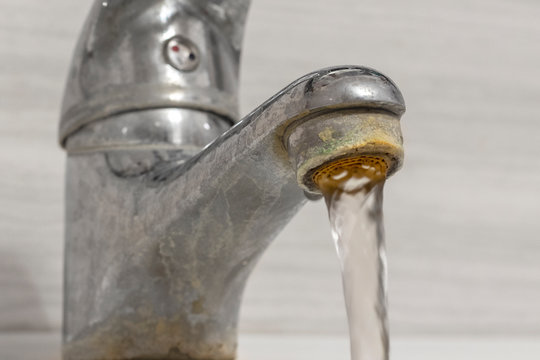
Mineral ions like magnesium and calcium are commonly found in water supplies and can eventually form large-scale deposits after being exposed to regular contact with water.
While scale build-up isn’t uncommon, it will, unfortunately, cause some serious damage to your filter.
The good news is scale deposits are easy to spot. They are typically white in color and form a hard, crusty layer.
Check around your house for scale deposits; pay particular attention to your faucets and shower heads.
Scale deposits aren’t the only thing you have to worry about, however, If your water is sourced directly from a ground reservoir – without any sort of filtering process already in place – it’s likely that you’ll have to contend with hard water too.
Hard water is so called because it contains varying amounts of chemicals, minerals, and other substances like dirt which can clog up your filter.
You can try to remove some of this sediment by washing the filter with a clean water spray.
Spray the water from the reverse direction of the filter, but be careful not to damage it in the process.
Unfortunately, if you live in an area with high amounts of chemicals and substances in the water supply, wear is unavoidable. You will have to replace your filter more frequently.
Final Thoughts On ZeroWater Draining Issues
Like any device that sees regular use, ZeroWater filters need to be treated with care and respect in order to be effective.
Despite the efficacy of their 5-step filtration process, their physical composition is remarkably fragile and prone to all kinds of damage.
It pays dividends to take the extra time needed to ensure that your ZeroWater filter is properly looked after.
Replacing the filters properly, removing any air bubbles, cleaning the housing area – all this will improve your ZeroWater filter’s lifespan, saving you time and money in the process.
Oh, and you’ll also be left with clean, safe drinking water to boot !

Founder of homeappliancegeek.com, avid cook, and lover of Asian food.
Signature dishes include Thai Red Curry, Chicken Saag, Bibimbap and Sushi.
Massive clean freak; a habit baked-in after spending 9 years in the catering industry.
The one appliance he couldn’t live without? Easily the dishwasher (total relationship saver!).