If you have a small kitchen or live in a flat, a full-sized dishwasher may not be an option. Fortunately, there is a solution – a table top dishwasher.
These compact dishwashers are designed to fit on your countertop and take up less space than a regular dishwasher.
But how do table top dishwashers work?
Table top dishwashers work in much the same way as full-sized dishwashers. They use hot water and detergent to clean your dishes, followed by a rinse cycle to remove any remaining soap. The main difference is that they are smaller and more compact, making them ideal for smaller kitchens or for those who don’t have the space for a full-sized dishwasher.
In this article, we’ll take a closer look at the key features of table top dishwashers, their capacity and place settings, the best place to put a countertop dishwasher, the installation and setup process and much more.
By the end of this article, you’ll have a better understanding of whether a table top dishwasher is right for you.
Key Takeaways
- Table top dishwashers work in much the same way as full-sized dishwashers, but are smaller and more compact.
- They are ideal for smaller kitchens or for those who don’t have the space for a full-sized dishwasher.
- Understanding their key features, capacity, installation process, and maintenance is important to determine if a table top dishwasher is right for you.
Table of Contents
How do Table Top Dishwashers Work?
Table top dishwashers are compact and portable dishwashers that can be placed on a countertop or a table.
They are a convenient option for small kitchens or for people who don’t have the space for a full-sized dishwasher.
Water supply
Table top dishwashers require a freshwater supply to deliver water as needed. The water supply is connected to the inlet hose of the dishwasher.
The inlet hose is usually located at the back of the dishwasher. The water supply is important to ensure that the dishwasher can clean the dishes properly.
Heating
Once the water supply is connected, the dishwasher heats the water to a high temperature. The hot water is necessary to remove grease and food particles from the dishes. Some dishwashers have a built-in heating element, while others use the hot water supply from the sink.
Spraying
The hot water is sprayed onto the dishes using a rotating arm. The arm sprays the water onto the dishes from different angles to ensure that all the dishes are cleaned thoroughly. Some dishwashers have multiple arms to ensure that all the dishes are cleaned properly.
Detergent
Detergent is added to the dishwasher to help clean the dishes. The detergent is usually in the form of a tablet or pod that dissolves in the hot water. The detergent helps to break down grease and food particles, making it easier for the dishwasher to clean the dishes.
Draining
Once the dishes are cleaned, the dirty water is drained out of the dishwasher using the outlet hose. The outlet hose is usually connected to the sink drain or a separate drain pipe. It is important to ensure that the outlet hose is connected properly to avoid any leaks.
Understanding Table Top Dishwashers
If you’re looking for a compact appliance that can save you time and space in your kitchen, a table top dishwasher might be just what you need.
These small dishwashers are designed to fit on your kitchen counter or table, making them perfect for small kitchens or for those who don’t have the space for a full-size dishwasher.
Table top dishwashers work in much the same way as full-size dishwashers, using a combination of water, detergent, and heat to clean your dishes.
The main difference is that they are smaller and more compact, making them easier to store and move around your kitchen.
One of the biggest advantages of a table top dishwasher is its size. These appliances are much smaller than full-size dishwashers, so they can fit on your kitchen counter or table without taking up too much space.
This makes them ideal for small kitchens or for those who don’t have the space for a full-size dishwasher.
Another advantage of a table top dishwasher is its portability. These appliances are designed to be moved around your kitchen, so you can easily take them with you if you move house or if you need to use them in a different room.
When it comes to installing a table top dishwasher, it’s important to make sure that you have enough space on your kitchen counter or table.
You’ll also need to make sure that you have access to a standard sink faucet, as table top dishwashers typically connect to your sink for water and drainage.
Key Features of Table Top Dishwashers
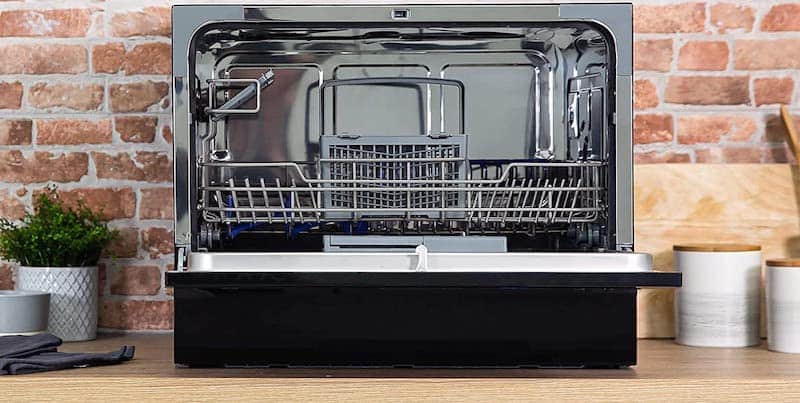
Table top dishwashers are a great solution for small households, individuals, couples, or roommates, who don’t have the space or need for a full-size dishwasher.
They come with a variety of features that make them convenient and efficient to use. Here are some of the key features you should look for when choosing a table top dishwasher:
Size and Capacity
Table top dishwashers are compact and take up minimal space. They can fit on a countertop or a table and are ideal for small kitchens. They usually have a capacity of between 2 and 8 place settings, which is suitable for small households of up to 5 people.
Programs and Settings
Table top dishwashers come with a range of programs and settings to suit different needs. Some models have intensive programs for heavily soiled dishes, while others have rapid programs for quick cleaning.
Delay timers are also available to allow you to set the dishwasher to start at a convenient time. Sensors are also included in some models to detect the level of dirtiness and adjust the wash accordingly.
Self-Cleaning
Some table top dishwashers come with a self-cleaning feature that helps to keep them hygienic and free from odours. This feature uses high-temperature water to clean the interior of the dishwasher and eliminates bacteria and germs.
Extra Drying
Extra drying options are available in some models to ensure that your dishes are completely dry after washing. This feature uses additional heat or fan-assisted drying to remove any excess moisture from your dishes.
Table Top Capacity and Place Settings
Table top dishwashers have a smaller capacity than full-size machines, typically ranging from 2 to 8 place settings. A place setting refers to the number of items that can be washed in one cycle, including plates, bowls, cutlery, glasses, and mugs.
If you are living in a small household of no more than 5 people, a table top dishwasher with a 6 place setting capacity should be sufficient for your needs.
However, if you regularly entertain guests or have a larger family, you may want to consider a larger capacity dishwasher with 8 place settings.
It’s important to note that the capacity of a dishwasher is not just determined by the number of place settings it can hold. The size and shape of your dishes also play a role.
For example, a dishwasher with a 6 place setting capacity may be able to hold 6 dinner plates, 6 side plates, 6 bowls, and cutlery for 6 people, but it may not be able to fit larger items like pots and pans.
Most table top dishwashers come with a silverware basket and racks that can be adjusted to accommodate different sizes of dishes. Some models also have fold-down tines that allow you to fit larger items in the dishwasher.
Best Place to Put a Countertop Dishwasher?
When it comes to installing a countertop dishwasher, one of the most important considerations is the location. You want to make sure that the dishwasher is placed in a spot that is both convenient and functional.
Near a Sink
One of the most important things to consider when installing a countertop dishwasher is its proximity to a sink. This is because the dishwasher will need to be connected to a water source, and the easiest way to do this is to connect it to the sink faucet.
Therefore, it is best to place the dishwasher near a sink so that the intake hose can readily connect to the faucet.
On a Stable Surface
Another important consideration is the stability of the surface on which the dishwasher will be placed. Countertop dishwashers are designed to be placed on a flat surface, such as a countertop or table.
Make sure that the surface is stable and level, and that it can support the weight of the dishwasher and the dishes inside.
Away from Heat Sources
Countertop dishwashers should also be placed away from heat sources, such as ovens and stovetops. This is because the heat can cause damage to the dishwasher and its components. Additionally, placing the dishwasher near a heat source can increase the risk of fire.
In a Convenient Location
Finally, it is important to consider the convenience of the location. You want to make sure that the dishwasher is easy to access and use.
Therefore, it is best to place the dishwasher in a location that is close to where you will be using it, such as near the dining table or the kitchen sink.
Table Top Installation and Setup Process

Step 1: Check the Requirements
Before you start the installation process, make sure that you have everything you need. A table top dishwasher requires a power supply, a freshwater supply to deliver water through the inlet hose, and a place to feed the waste hose out to.
You may also need an adaptor to connect the dishwasher to your kitchen faucet.
Step 2: Prepare the Area
Clear a space on your kitchen counter for the dishwasher. Make sure that the area is level and stable. You may need to adjust the feet of the dishwasher to ensure that it is level.
Step 3: Connect the Inlet Hose
Connect the inlet hose to your kitchen faucet. If your faucet does not have a threaded outlet, you may need to use an adaptor. Make sure that the connection is tight and secure.
Step 4: Connect the Drain Hose
Connect the drain hose to a sink or drain. Make sure that the connection is tight and secure.
Step 5: Plug in the Dishwasher
Plug the dishwasher into a power outlet. Make sure that the outlet is grounded and that the cord is not damaged.
Step 6: Run a Test Cycle
Fill the dishwasher with dishes and detergent and run a test cycle. Check for leaks and make sure that the dishwasher is functioning properly.
By following these simple steps, you can easily install and set up your table top dishwasher in no time.
Efficiency and Eco-Friendliness
When it comes to table top dishwashers, efficiency and eco-friendliness are important factors to consider.
These machines are designed to use less water and energy compared to traditional dishwashers, making them an excellent choice for those who want to reduce their environmental impact and save on energy bills.
How much water does a table top dishwasher use?
Table top dishwashers typically use less water than traditional dishwashers. Most models use around 6-8 litres of water per cycle, which is significantly less than the 12-15 litres used by larger machines.
This means that you can save water and reduce your water bills by using a table top dishwasher.
In addition to using less water, table top dishwashers are also designed to be energy-efficient. Most models have an A+ energy rating, which means they use less energy than traditional dishwashers.
This can help you save money on your energy bills while reducing your carbon footprint.
Many table top dishwashers also come equipped with sensors that detect how dirty your dishes are and adjust the water and energy usage accordingly.
This means that the machine will use less water and energy for lightly soiled dishes, further reducing your environmental impact.
Different Types and Brands Of Table Top Dishwashers

When it comes to table top dishwashers, there are several types and brands to choose from. Here are some of the most popular:
Countertop Dishwashers
Countertop dishwashers are compact and designed to sit on top of your counter. They are ideal for small kitchens or for those who don’t have space for a full-size dishwasher.
They can typically hold up to six place settings and are easy to install.
Table Top Dishwashers
Table top dishwashers are similar to countertop dishwashers, but they are designed to be freestanding. They are slightly larger than countertop models and can typically hold up to eight place settings. They are also easy to install and are a great option for small kitchens.
Mini Dishwashers
Mini dishwashers are even smaller than countertop and table top models. They are designed to be portable and can be moved from one location to another.
They are typically designed to hold up to four place settings and are perfect for small apartments or for those who don’t have a lot of space.
Integrated Dishwashers
Integrated dishwashers are designed to be built into your kitchen units. They are concealed behind a cabinet door and can be a great option if you want your dishwasher to blend in with your kitchen. They are available in a range of sizes and can hold varying numbers of place settings.
Freestanding Dishwashers
Freestanding dishwashers are designed to stand alone in your kitchen. They are not built into your units and are available in a range of sizes. They can hold varying numbers of place settings and are a great option if you want a dishwasher that can be moved around.
Slimline Dishwashers
Slimline dishwashers are designed to be narrower than standard dishwashers. They are typically around 45cm wide and can hold up to 10 place settings. They are a great option if you don’t have a lot of space in your kitchen.
Brands
When it comes to table top dishwashers, there are several brands to choose from. Some of the most popular brands include Klarstein, Essentials, and Russell Hobbs.
Cleaning and Maintenance
To keep your table top dishwasher working effectively, it’s important to clean and maintain it regularly.
How do I drain a table top dishwasher?
To drain a table top dishwasher, simply connect the outlet hose to your sink drain and turn on the tap. The dirty water will flow out through the hose and into the sink. Make sure to empty the sink before starting the dishwasher to prevent any overflow.
Cleaning the filter
The filter is an important part of your dishwasher as it collects food particles and debris from the water. It’s important to clean the filter regularly to prevent blockages and ensure your dishwasher works effectively.
To clean the filter, remove it from the dishwasher and wash it in warm soapy water. Make sure to rinse it thoroughly before replacing it.
Cleaning the spray arms
The spray arms are responsible for distributing water throughout the dishwasher to clean your dishes. Over time, they can become clogged with food particles and debris, which can affect their performance.
To clean the spray arms, remove them from the dishwasher and use a cocktail pick to remove any material from the holes. Rinse the arms under running water to remove any remaining debris.
Using dishwasher cleaner
Using a dishwasher cleaner can help to remove any built-up grease and limescale from your dishwasher. Simply follow the instructions on the cleaner and run a cycle with an empty dishwasher.
This will help to keep your dishwasher clean and fresh.
Adding dishwasher salt and rinse aid
Dishwasher salt and rinse aid are essential for keeping your dishwasher working effectively. Dishwasher salt helps to soften the water, which can improve the cleaning performance, while rinse aid helps to prevent water spots and streaks on your dishes.
Make sure to follow the instructions on your dishwasher for adding salt and rinse aid.
Comparing Table Top Dishwashers with Full-Sized Dishwashers
Both types of dishwashers have their advantages and disadvantages, so it’s important to weigh up your options before making a decision.
Size and Dimensions
One of the most obvious differences between table top dishwashers and full-sized dishwashers is their size. Table top dishwashers are much smaller and more compact than full-sized dishwashers, making them ideal for smaller kitchens or those with limited space.
They typically have a capacity of between 2 and 8 place settings, compared to the 9-16 place settings of full-sized machines.
Portability
Table top dishwashers are also more portable than full-sized dishwashers, which are usually built-in to your kitchen units.
This means that you can easily move a table top dishwasher from one location to another if needed.
Material and Finish
Full-sized dishwashers are usually made from stainless steel, which is durable and long-lasting. Table top dishwashers, on the other hand, are often made from plastic, which is lightweight and easy to move around.
Motor and Spray Arms
Despite their smaller size, table top dishwashers still have a powerful motor and spray arms, which ensure that your dishes are cleaned thoroughly.
However, full-sized dishwashers often have more advanced motor and spray arm technology, which can result in even better cleaning performance.
Programmes and Washing Programs
Both table top dishwashers and full-sized dishwashers offer a range of washing programmes to suit different types of dishes and levels of soiling.
However, full-sized dishwashers often have more programmes to choose from, which can be useful if you have specific cleaning requirements.
Cost Effective To Use Table Top Dishwasher?
When it comes to purchasing a dishwasher, cost is an important factor to consider. Table top dishwashers are generally more cost-effective than full-size dishwashers, making them a great option for those on a budget.
Table top dishwashers typically have a lower purchase price compared to full-size dishwashers. Additionally, they use less water and energy, which can result in lower operating costs.
The cost of running a dishwasher can vary depending on factors such as energy rates and the dishwasher’s energy efficiency rating.
According to Ideal Home, the cost of running a dishwasher is set to rise to a maximum of 34p per kWh following the announcement of the energy price freeze that will come into effect in October 2022.
However, the actual cost of running a table top dishwasher will depend on its energy efficiency rating and the amount of water it uses per cycle.
In terms of water usage, table top dishwashers typically use less water compared to full-size dishwashers. For example, the Russell Hobbs RHTTDW6S table top dishwasher uses only 6.5 litres of water per cycle.
This is great news for those who are conscious about their water usage and want to save on their water bills.
Frequently Asked Questions
What is the process of connecting a table top dishwasher to a tap?
Connecting a table top dishwasher to a tap is a straightforward process. First, ensure that your tap has a threaded aerator on the end.
Then, connect the dishwasher hose to the aerator, making sure it is secure. Turn on the water supply and plug in the dishwasher. You’re now ready to use your table top dishwasher.
Do table top dishwashers require plumbing?
No, table top dishwashers do not require plumbing. They are designed to be portable and can be connected to a tap with a threaded aerator.
This makes them a great option for those who live in rented accommodation or have limited space in their kitchen.
Are countertop dishwashers a worthwhile investment?
Yes, countertop dishwashers can be a worthwhile investment. They are a convenient and efficient way to clean your dishes, and they take up less space than a full-size dishwasher.
They are also more affordable than a built-in dishwasher, making them a great option for those on a budget.
How much water do countertop dishwashers use?
Countertop dishwashers use less water than hand washing your dishes. On average, they use around 4-6 litres of water per cycle, depending on the model. This makes them an eco-friendly option, as they use less water and energy than a full-size dishwasher.

Founder of homeappliancegeek.com, avid cook, and lover of Asian food.
Signature dishes include Thai Red Curry, Chicken Saag, Bibimbap and Sushi.
Massive clean freak; a habit baked-in after spending 9 years in the catering industry.
The one appliance he couldn’t live without? Easily the dishwasher (total relationship saver!).